
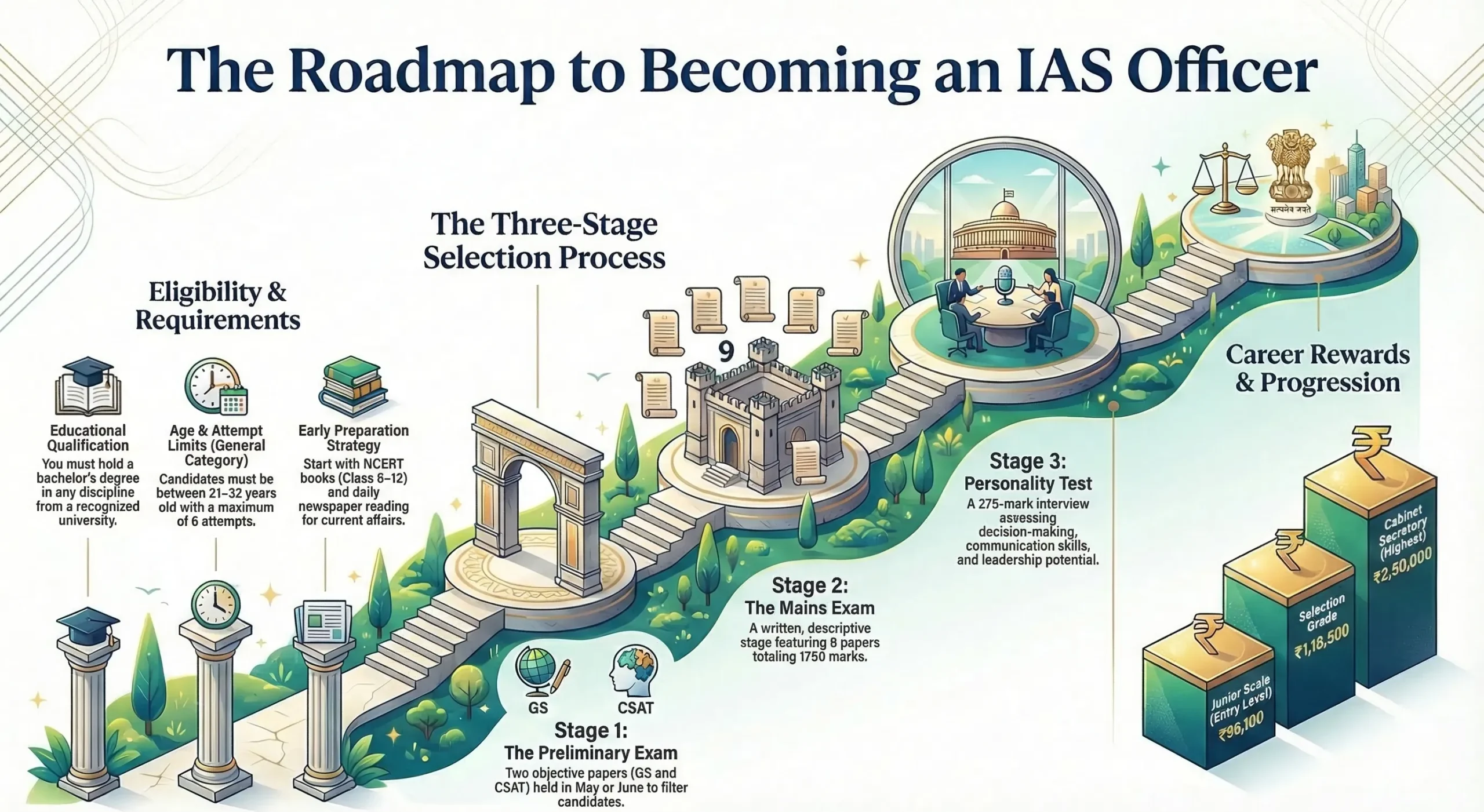
Do you want to become an IAS or IPS official shortly after you graduate from school? Many students question how to Prepare For UPSC after 12th. The reality is that beginning early offers you a significant edge. UPSC is one of India’s most difficult examinations, but with the correct plan, resources, and mentality, you may lay a solid foundation from Class 12 onward. This book will guide you through practical procedures, preparation advice, and resources to help you get started on your UPSC journey.
Understanding UPSC Basics
Before diving into preparation, it’s important to know what UPSC is all about. The Union Public Service Commission conducts the Civil Services Examination (CSE) to recruit candidates for prestigious posts like IAS, IPS, IFS, and IRS. The exam has three stages:
- Prelims – Objective-type questions.
- Mains – Descriptive papers.
- Interview – Personality test.
Starting after Class 12 means you have 3–4 years to build a strong base before you become eligible to appear (minimum age is 21).
Why Start UPSC Preparation After 12th?
- Early Foundation: You can master NCERTs and basics before college ends.
- Time Advantage: More years to practice writing answers and essays.
- Confidence Boost: Familiarity with syllabus reduces exam stress later.
- Balanced Growth: You can align your graduation subjects with UPSC optional papers.
UPSC Preparation Tips
Here are some practical tips for students wondering How to Prepare For UPSC After 12th:
- Begin With NCERTs: Read Class 6–12 NCERT books for History, Geography, Polity, and Economics.
- Build Reading Habits: Start reading newspapers such as The Hindu or the Indian Express daily.
- Understand the Syllabus: Download the UPSC syllabus and keep it handy.
- Choose Graduation Wisely: Pick a subject that overlaps with UPSC optional papers.
- Practice Writing: Begin writing short notes and answers to improve descriptive skills.
- Use Online Resources: Explore free courses, YouTube lectures, and government portals.
- Stay Consistent: Make a timetable and stick to it – even 2 hours daily matters.
- Mock Tests: Try simple quizzes to test your knowledge.
- Stay Updated: Follow current affairs regularly.
- Stay Positive: UPSC is a marathon, not a sprint – patience is key.
Strategy for UPSC Preparation After 12th
- Year 1 (Class 12 + First Year of College): Focus on NCERTs, basic GK, and newspapers.
- Year 2: Start standard UPSC books like Laxmikant (Polity), Spectrum (History), and Ramesh Singh (Economics).
- Year 3: Practice answer writing, join test series, and revise current affairs.
- Year 4: Full‑fledged preparation with mock exams, revision, and optional subject mastery.
How to Prepare For UPSC After 12th – Resources You Can Use
- Books: NCERTs, Laxmikant, Spectrum, Ramesh Singh, Shankar IAS Environment.
- Websites: UPSC official site, PIB, Rajya Sabha TV transcripts.
- Apps: Vision IAS, InsightsIAS, ClearIAS.
- Courses: Free online courses on SWAYAM, NPTEL, and YouTube channels.
Common Mistakes to Avoid
- Ignoring NCERT basics.
- Relying only on coaching without self‑study.
- Not practicing answer writing.
- Overloading with too many books.
- Skipping current affairs.
🔗 Related Post You Should Read
If you’re also looking for IIM Bangalore Online Courses, don’t miss our detailed article on the IIM Bangalore Free Online Courses – Official Link, Syllabus & Certificate Info – View Full Details. 👉 Click Here
Conclusion
Starting early is the smartest move if you’re serious about cracking UPSC. By focusing on NCERTs, building strong reading habits, and gradually moving to advanced resources, you’ll be well‑prepared when you finally sit for the exam. Remember, how to Prepare For UPSC after 12th is not about rushing – it’s about steady progress, discipline, and consistency. With the right mindset and resources, your UPSC dream can become a reality.